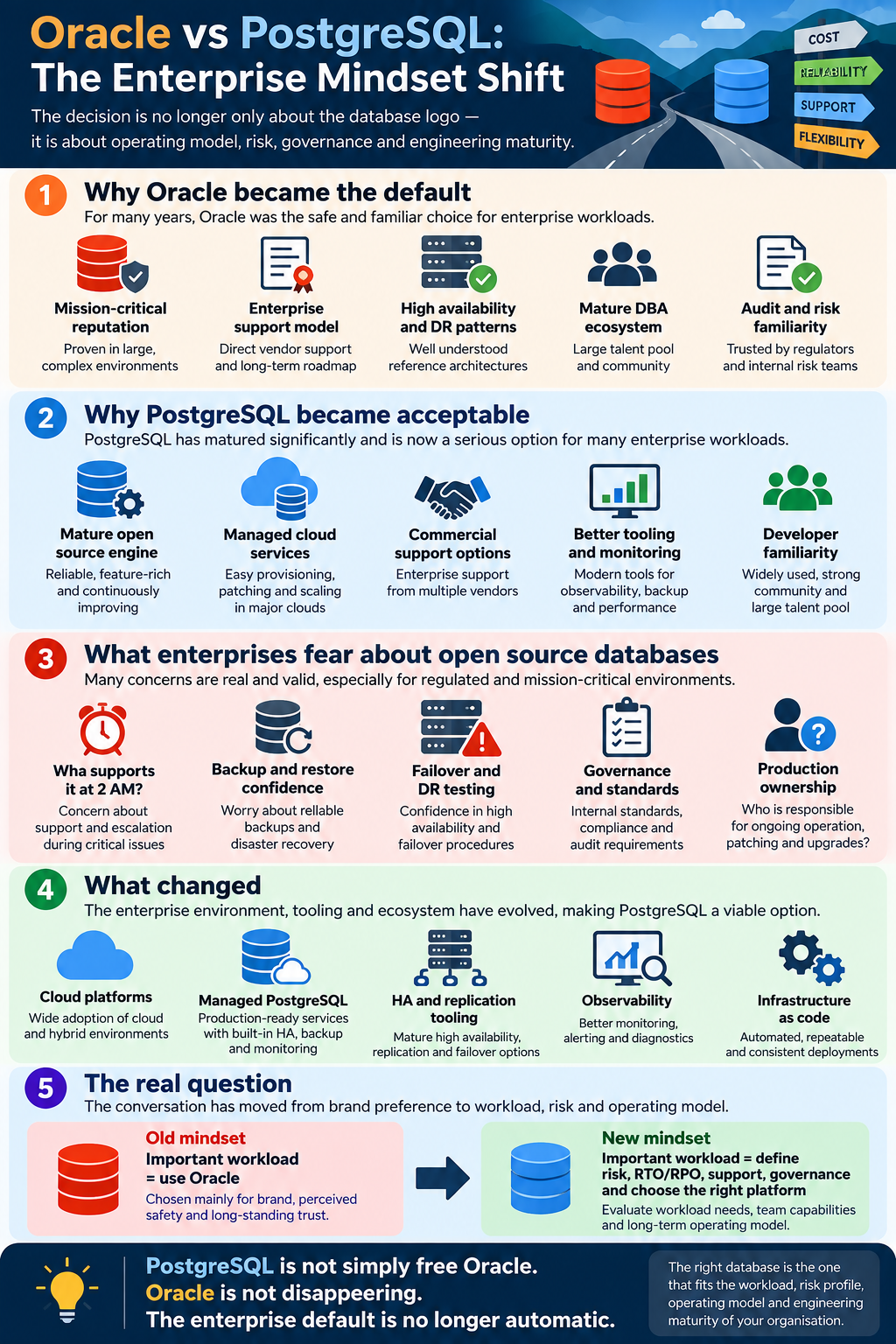
There was a time when the idea sounded almost unrealistic: a large bank choosing an open source database instead of a traditional enterprise database platform.
For years, Oracle was the safe answer. If the application was important, if the data was sensitive, and if the organisation needed support, auditability and long-term confidence, Oracle was often the default choice.
That default is changing.
PostgreSQL is no longer viewed only as a developer-friendly open source database. In many enterprises, including financial services, it is now part of serious database-modernisation conversations. Public case studies from PostgreSQL vendors describe financial organisations using Postgres for cost flexibility, virtualised environments, Oracle compatibility, and operational support. That does not mean every core banking platform is suddenly moving away from Oracle, but it does show that open source databases are now considered viable for workloads that would once have automatically gone to commercial enterprise platforms.
Why this changed
The change is not only about licence cost. Cost matters, but it is not the full story.
PostgreSQL became more acceptable because the ecosystem around it matured. There are now managed PostgreSQL services from major cloud providers, commercial support options, better migration tooling, stronger monitoring, high availability patterns, and a much larger pool of engineers who understand the platform.
That matters because a bank does not only choose a database engine. It chooses an operating model.
The real question is operational confidence
Open source does not remove enterprise responsibility. PostgreSQL still needs backups, recovery testing, patching, monitoring, access controls, performance tuning, capacity planning and production support.
The database may be open source, but production is never free.
This is where the mindset shift becomes important. The question is no longer simply:
Is this an enterprise database product?
The better question is:
Can we operate this database safely for this workload?
Oracle is not disappearing
Oracle still makes sense for many workloads. Some applications depend heavily on Oracle-specific features. Some estates have years of PL/SQL, tooling, operational practices and vendor support built around Oracle. For those systems, migration may not be worth the risk.
But Oracle is no longer the automatic answer for every serious workload.
That is the real change. Enterprises are becoming more workload-driven. New applications may choose PostgreSQL. Existing Oracle platforms may stay where they are. Some systems may move gradually. Others may never move. The mature answer is not one database for everything, but the right database with the right engineering around it.
Final thought
PostgreSQL did not become credible in banks only because it was open source. It became credible because open source, cloud platforms, enterprise support, automation and database engineering matured together.
The surprising part is not that banks are looking at PostgreSQL. The surprising part is how normal that conversation has become.
Related reading: EDB has published examples of financial services organisations adopting Postgres in Oracle-heavy environments, and major cloud providers now offer managed PostgreSQL services as part of their standard database platforms.